
As a trauma-informed Advocate, people often ask me how I know how to create such safe spaces for difficult conversations. The answer is deeply personal - and it starts with understanding that sometimes the most profound healing happens not through words or techniques, but through presence, patience, and unconditional acceptance.
One of the biggest barriers to authentic living is the shame we carry around our trauma responses - the ways we've learned to protect ourselves that others might not understand. Today I want to share something deeply personal about my own healing journey, and how it's shaped both my understanding of trauma and the way I approach my work with clients who are ready to shatter shame and choose themselves.
For most of my life, I've been surrounded by animals. Growing up, dogs were our guardians, our protectors, our nannies. While I experienced trauma and violence at the hands of humans, it was always animals—mostly dogs—that taught me about compassion and unyielding love. They taught me about responsibility, caring for life beyond my own, joy, and grief.
But more than that, animals taught me the importance of caring for life beyond myself. Animals do not choose who owns them, the same way children don't choose their parents. It is our job, our duty, to be responsible for them and to give them everything they need, to set them up for success. Animals taught me that unconditional care isn't just about love—it's about creating safety, providing consistency, and understanding that sometimes the most broken creatures need the gentlest approach. Animals taught me all of this. Now I want to teach humans their lessons.
When I got older and worked in veterinary clinics and zoos, I discovered I had a particular gift with "problem" animals—dogs labeled as aggressive or skittish. I made it my mission to gain their trust, and I did. I learned to approach them with calm energy, to get on their level, to let them set the pace for connection. I learned that excited energy, even positive energy, could be overwhelming. I discovered the power of simply being present without demands, of becoming a safe space they could use to complete their stress cycles.
It wasn't until years later, during my own healing journey, that I realized I had been describing myself all along.
My partner had been deployed for six months—military life meant long separations and the uncertainty that comes with loving someone whose job takes them far away. We talked every single day, but talking isn't the same as being present with each other. During those months apart, I was doing intensive work in therapy, processing years of unprocessed trauma. As the day grew closer for him to come home, I realized I was scared. Scared that I would be too different. Scared that we wouldn't connect like we once did. Scared of him, now that I understood so much of my trauma had come from men.
When he finally came home, he came bounding through the door, excited to see me after all that time. But I was laying in a little nest I had made, almost cowering. I didn't move when he came in—I just curled into myself and watched him. As soon as he saw me, he calmed down and put his things down. When he came closer, I flinched, and he slowed his pace even more.
Then he did something extraordinary: he knelt down beside me and put his back to me, sitting in silence. He didn't speak, didn't try to touch me. He just let me exist in his presence. Slowly, I came out of my nest, moving closer to him. I nudged his shoulder, and he slowly turned to partially face me. When he smiled and reached for me, I didn't pull away. I let him touch my cheek, then my hair. Only then did I feel safe enough to push my face into his hands, to let him hold me.
Still on my level. Still no words. After holding each other, I found my voice. I told him I loved him and how much I missed him. I thanked him for being so gentle. We eventually moved to our bed where we just laid together, wrapped in each other, like our souls were learning each other again. Still timid, but safe.
In that moment, I realized what he had done: he had treated me exactly the way I treated those rescue dogs in the clinic. He had used the same gentle approach—calm presence, getting on my level, letting me set the pace, non-verbal communication, and infinite patience.
That's when it became clear: I have a rescue dog personality and a service dog attachment style.
Like a rescue dog, I can get skittish and nervous. During those moments, I need space from others and comfort from my trusted humans. You can't jump and grab at rescue dogs—they might run or even snap. Excited energy, even positive energy, can be too much in moments of overwhelm. What we need is someone to be a grounding rod, a calm presence that lets us use them to complete our stress cycles, like a mother calms her baby.
Trauma survivors aren't damaged goods. We are vessels of great suffering, and when there is nothing safe to pour it into, we threaten to crack under the weight of it all. Love and kindness are what help the cracks fuse together, like bones and skin healing. Something new must grow in the empty space to fill the gap, making us whole and stronger than before.
The approach is simple but profound: be gentle. Create a stable place to jump off from. During overwhelm, provide space and comfort. Be that grounding presence. Move slowly. Have no expectations, no obligations, nothing to achieve. Just exist, as you are, and let them exist as they are. Nothing else.
This understanding has become the foundation of how I approach my own healing and how I help others understand trauma responses. It's about creating safety and support, being present without pressure, and trusting that connection will happen when the person feels safe enough to reach out.
Whether you're a military family navigating reintegration, a partner trying to support someone through their healing journey, or simply someone who wants to understand how to love through trauma—the lessons are the same. Sometimes the most profound healing happens not through words or actions, but through patient presence and unconditional acceptance.
The animals taught me well. Now I want to teach their lessons to the humans who need them most.
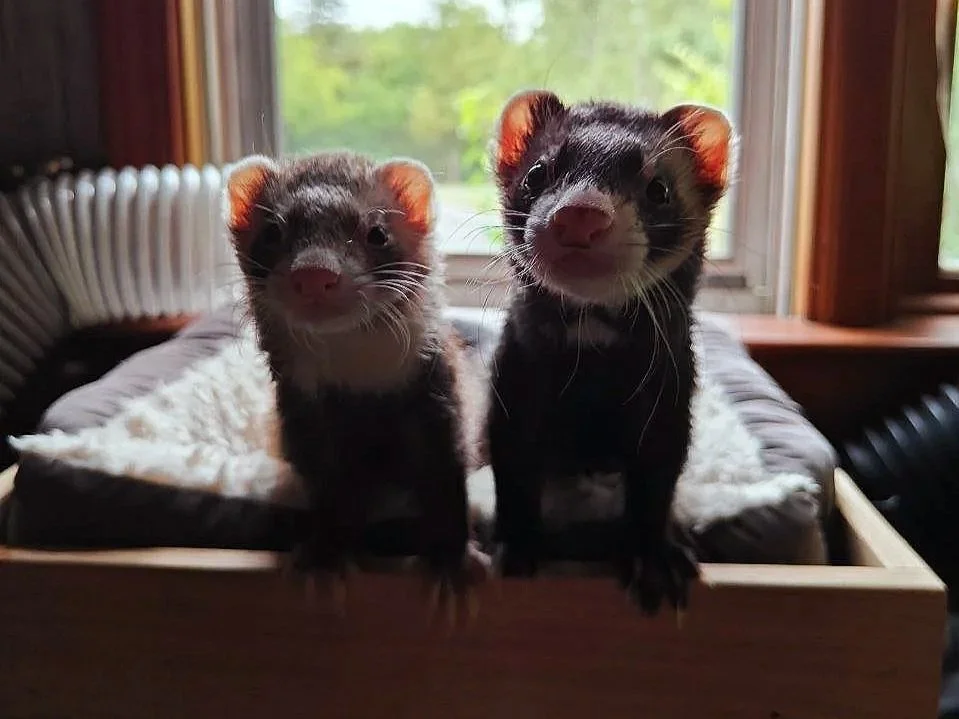
Best wishes & Ferret kisses,
